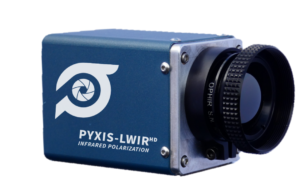
Why Polarimetric Imaging Changes Everything: Introducing the Pyxis® Series
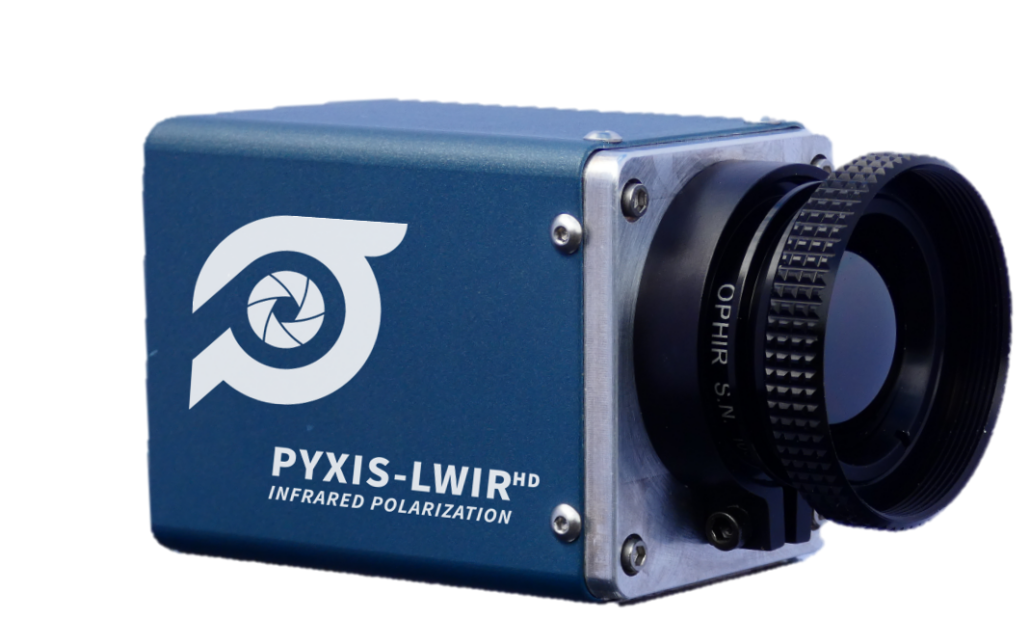
Standard thermal cameras measure heat. The Pyxis® series from Polaris Sensor Technologies measures something thermal cameras cannot — polarization. That single difference opens up a category of detection capabilities that have no equivalent in conventional infrared imaging.
What thermal cameras miss
A thermal camera reveals temperature differences. When a target is warmer or cooler than its background, it stands out. But real-world conditions routinely defeat that assumption. At dawn and dusk, targets reach thermal equilibrium with their surroundings and disappear entirely from a thermal image. Targets hidden in shade have no solar loading and blend into the background. Vehicles parked under trees, objects partially obscured by foliage, targets with just a few pixels on sensor — all of these are scenarios where thermal imaging alone falls short.
Polarization doesn’t have those limitations. Man-made objects emit polarized infrared radiation as a function of their surface geometry and material composition. Natural backgrounds — terrain, vegetation, water — are largely unpolarized. That physical difference exists regardless of temperature, time of day, or whether the target is in shade or sun. The Pyxis exploits that difference in real time.
How it works
The Pyxis uses a pixelated polarizer array integrated directly onto the focal plane. Rather than rotating a filter or making multiple sequential exposures, it captures all polarization states simultaneously in a single snapshot — making it immune to motion artifacts from either the sensor or the scene. The result is real-time output of four simultaneous data streams: thermal intensity, Degree of Linear Polarization (DoLP), Angle of Polarization (AoP), and eTherm® — Polaris’s proprietary color fusion image.
eTherm® maps temperature to brightness, DoLP to color saturation, and orientation to hue. Objects sharing the same surface orientation appear in the same color, giving operators an intuitive, information-dense view of the scene that goes far beyond what a grayscale thermal image can convey.
Proven in the field
The Pyxis has been tested extensively on handheld, vehicle-mounted, and UAS platforms. In one documented test at Redstone Arsenal, targets hidden in grass and weeds at nighttime — when target temperatures were nearly identical to ground temperatures — were completely invisible in the thermal image. In the polarization image, they stood out clearly. In another test, a truck parked behind a tree was undetectable thermally. Its polarization signature was visible through gaps in the foliage.
For oil spill detection, the Pyxis has demonstrated the ability to detect oil as thin as 50 µm on water, distinguishing it from vegetation, sea kelp, and sun glint at distances up to one kilometer — a task where thermal cameras consistently underperform.
Three configurations
The Pyxis is available in three spectral configurations:
- LWIR HD — 7.5–13.5 µm, 1024×1024 resolution, 241 g with lens, 9 or 30 Hz frame rate
- SWIR — 0.6–1.7 µm, 640×512 resolution, InGaAs detector, up to 60 Hz
- VIS — 400–900 nm, 2448×2048 resolution (5 MP), CMOS Mono, up to 30 Hz
All three models use the same pixelated polarizer architecture and are compatible with Polaris’s Vega software for real-time sensor control, data acquisition, and analysis.
Applications
The Pyxis is deployed across ISR, counter-UAS, route clearance, maritime surveillance, oil-on-water detection, autonomous navigation, and facial recognition applications. It is battery-operated, platform-agnostic, and available only in the United States.
For specifications and ordering information, visit our Pyxis product page or contact us at sales@infraredimaging.com.

